The Future of Tesla Amid Rising Competition from BYD and China’s EV Giants
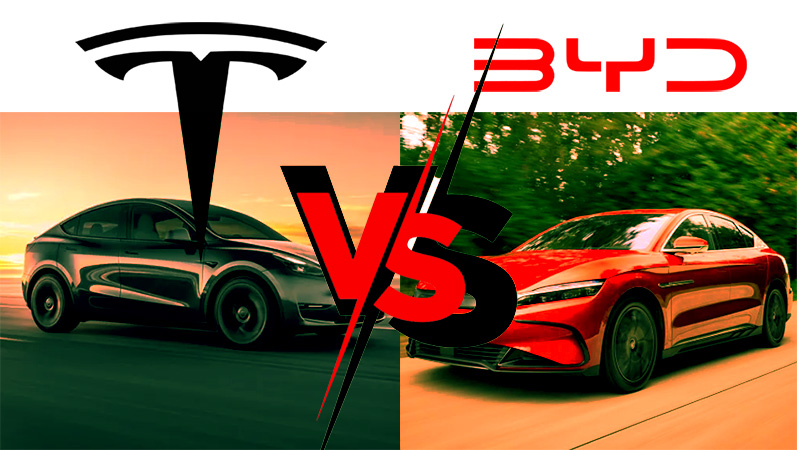
As the global electric vehicle (EV) market accelerates, Tesla—long the undisputed leader—finds itself facing unprecedented competition from China’s BYD (Build Your Dreams) and other emerging Chinese automakers. Once praised for its unchallenged innovation and scalability, Tesla is now under pressure across multiple dimensions: technology, production volume, and global pricing dynamics.
BYD: The New Powerhouse
BYD has surged ahead rapidly, with aggressive pricing strategies, deep vertical integration, and increasingly advanced EV models. In 2024, BYD overtook Tesla in total EV sales, marking a historic moment in the global EV race. Unlike Tesla, which outsources many components, BYD produces batteries, chips, and electric drivetrains in-house, giving it tighter control over costs, quality, and supply chains.
BYD, backed by Warren Buffett’s Berkshire Hathaway, has overtaken Tesla in global EV sales in some quarters, thanks to its vertically integrated supply chain and lower-cost models. Unlike Tesla, which focuses on premium vehicles, BYD offers a wide range of affordable EVs, from compact cars to buses, making it a formidable competitor in emerging markets.
Chinese automakers benefit from strong government support, cheaper labor, and domestic battery production (CATL being the world’s largest EV battery supplier). This allows them to undercut Tesla on price while maintaining competitive technology. For example, BYD’s Blade Battery is considered safer and more cost-effective than traditional lithium-ion batteries, putting pressure on Tesla’s battery strategy.
Where Tesla once set the benchmark for EV technology, BYD and its Chinese counterparts are closing the gap—or even surpassing it—in several areas. Models like the BYD Seal and Han offer range, battery efficiency, and onboard tech comparable to Tesla’s Model 3 and Model S, often at significantly lower prices.
Technical Compression: The End of the “Tech-Only” Advantage?
Tesla’s biggest advantage has been its cutting-edge technology, including Full Self-Driving (FSD) capabilities and industry-leading software. However, Chinese EV makers are rapidly closing the gap. Companies like XPeng and NIO offer advanced driver-assistance systems (ADAS) that rival Tesla’s Autopilot, often at a lower cost.
Tesla’s earlier dominance was built on its proprietary battery technology, Autopilot features, and over-the-air software updates. But these features are becoming standard in newer EVs from China. NIO, Xpeng, and Zeekr, alongside BYD, are pushing boundaries with driver-assistance systems, immersive infotainment, and battery-swapping capabilities.
Furthermore, BYD’s Blade Battery—renowned for safety, durability, and cost-efficiency—is considered a potential industry standard. Meanwhile, Tesla’s much-anticipated 4680 battery is still ramping up slowly, facing production bottlenecks.
With smart tech no longer being Tesla’s exclusive advantage, the brand must reassert its innovation leadership, particularly as Chinese automakers begin integrating AI-powered systems, voice interaction, and real-time traffic intelligence into their EVs.
Production Compression: Tesla’s Global Scaling Faces New Hurdles
Tesla has long been lauded for its “gigafactory” strategy, enabling cost-effective mass production. However, BYD and other Chinese players are now scaling faster, aided by government incentives, lower labor costs, and proximity to critical supply chains.
In 2025, BYD is expected to produce over 4 million vehicles, while Tesla’s target remains between 2.5–3 million. Additionally, Chinese automakers are expanding globally at record pace—building factories in Southeast Asia, Europe, and Latin America to bypass tariffs and cut costs.
Tesla’s recent price cuts, while boosting short-term demand, have also narrowed its profit margins. In contrast, BYD maintains profitability even at lower price points, thanks to its vertically integrated model and local manufacturing advantages.
The Road Ahead
Tesla still commands a strong global brand, a loyal customer base, and first-mover advantage in key markets like the U.S. and Europe. Its foray into energy storage, AI, and robotaxis could also unlock new revenue streams beyond EVs.
However, to retain leadership, Tesla must:
- Accelerate next-gen battery production (4680 and beyond)
- Localize production in growth markets like India and ASEAN
- Innovate in software and autonomous driving ahead of its rivals
- Navigate pricing wars without eroding brand equity or margins
As the EV market matures, it’s no longer about just leading—it’s about adapting. In a world where BYD and others are catching up fast, Tesla’s future hinges not on what it invented yesterday, but how it evolves tomorrow.
Technical Comparison: Tesla vs. BYD (2025)
| Specification | Tesla Model 3 (RWD/Performance) | BYD Seal (RWD/AWD) |
|---|---|---|
| Battery Type | Lithium-ion (Panasonic or CATL) | Blade Battery (LFP – lithium iron phosphate) |
| Battery Capacity | ~60–82 kWh (depending on model) | ~61.4–82.5 kWh |
| Range (WLTP) | 491–602 km | 550–650 km |
| 0–100 km/h Acceleration | 6.1s (RWD) / 3.3s (Performance) | 5.9s (RWD) / 3.8s (AWD) |
| Charging Speed (DC Fast) | Up to 250 kW (Supercharger V3) | Up to 150 kW |
| Drive System | RWD / AWD | RWD / AWD |
| Autonomous Driving | Tesla Autopilot / Full Self-Driving (FSD)* | BYD DiPilot (L2+ Advanced Driving Assist) |
| Infotainment | 15” touch screen with custom OS | 15.6” rotating screen, Android-based |
| Software Updates | Over-the-air (OTA) | Over-the-air (OTA) |
| Voice & Smart Assistant | Tesla Voice Assistant | BYD Xiaodi Voice + AI integration |
| Build Quality & Materials | Minimalist, modern cabin | Premium soft-touch materials, more luxury-oriented |
| Price (Starting – Global) | ~$38,000–$52,000 USD | ~$30,000–$45,000 USD |
| Warranty | 8 years / 160,000 km battery & drivetrain | 6 years / 150,000 km battery & drivetrain |
| Market Presence | Global (strong in US, Europe, China) | Expanding globally (strong in China, entering Europe, Middle East) |
🔹 Note: Tesla’s Full Self-Driving (FSD) is still not fully autonomous and varies in availability based on region and regulation.
Key Observations
- Battery Tech: BYD’s Blade Battery is praised for thermal safety and longevity, while Tesla is shifting to 4680 cells (cylindrical) for improved density and cost—still in early ramp-up.
- Charging: Tesla Supercharger network is unmatched globally; BYD lags in global charging infrastructure but catching up via partnerships.
- Autonomous Driving: Tesla’s FSD is more advanced in development but still controversial and limited by regulatory hurdles. BYD focuses on reliability and cost-efficient Level 2+ systems.
- Interior and Comfort: BYD offers more luxury and features at a lower price point, especially in China and emerging markets.
- Software: Tesla leads in seamless UI and real-time OTA updates. BYD is improving fast, especially with local AI integrations and rotating displays.